Monumental Thoughts – Part 1
 I lived in the Washington, DC area for 25 years, but this week is the first time I’ve been here purely as a tourist, visiting with a California friend who wanted to see the famous cherry blossoms. Washington definitely delivered. We didn’t just see cherry trees. We saw the product of generations of leaders, patriots, architects, historians, scholars, philanthropists, and ordinary citizens. And I felt overwhelmed with conflicting emotions, including pride, gratitude, disgust, anger, and shame.
We started with a tour of the capitol, which focused on its history and its art. The capitol rotunda hosts two statues provided by each state. Until recently these were all white men, including Confederate leaders. There are also murals and paintings that reflect, as the guide put it, “our history as we understood it at the time.” I appreciated that the guide made a point of showing us recent changes in the statuary that brought in a few women, people of color, and indigenous heroes and ushered out a few Confederates. He also noted that Rosa Parks and Justice Ruth Bader Ginsburg were the only two women to have lain in honor in the capitol after their deaths.
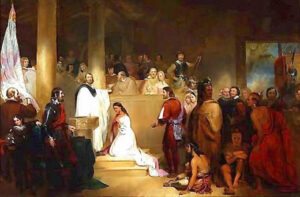 There were a few indigenous women in our tour group, and I noticed they were standing in front of a painting called “Baptism of Pocahontas” by John Gadsby Chapman. According to the US Capitol website, “This painting depicts the ceremony in which Pocahontas, daughter of the influential Algonkian chief Powhatan, was baptized and given the name Rebecca in an Anglican church. It took place in 1613 or 1614 in the colony at Jamestown, Virginia, … Pocahontas is thought to be the earliest native convert to Christianity in the English colonies; this ceremony and her subsequent marriage to John Rolfe helped to establish peaceful relations between the colonists and the Tidewater tribes.” I don’t know if anyone noticed the painting other than me, but it made me uncomfortable. I wanted to say something to them, like an apology, but I wasn’t sure whether/how to do it, so I didn’t. I was also not thrilled that California’s two statues are St. Junipero Serra and Ronald Reagan. I think Dolores Huerta and Sally Ride would have been better choices!
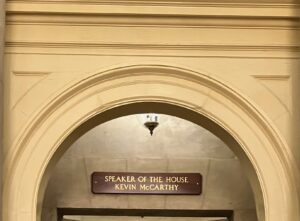 On the steps of the Capitol, as we were leaving, we saw a gathering of Democratic representatives calling for action on gun violence. I cheered them on, but sadly, those who are blocking sensible regulations, like reinstating the ban on assault weapons, refuse to listen. The tour hustled us past the Speaker’s office. It was clear how easy it was for the January 6 thugs to invade it. There were security people outside the door when we passed.
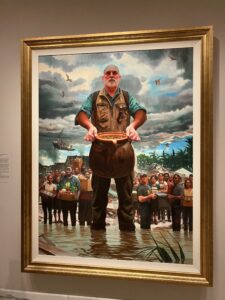 The National Portrait Gallery and American Art Museum of the Smithsonian was our next stop. A magnificent building with a very different collection of art. “Portrait of a Nation: 2022 Honorees” was the first exhibit we saw. Chef Jose Andres, founder of World Central Kitchen (we had just eaten at one of his restaurants, which supports his work in Ukraine and other disaster sites), Anthony Fauci, and Serena and Venus Williams were among the honorees.
 I paid my respects to Jimmy Carter, and Barack and Michelle Obama’s official portraits. I appreciated a large portrait of the first four female Supreme Court justices, as well as many galleries devoted to artists who represent a very broad spectrum of our diverse society.
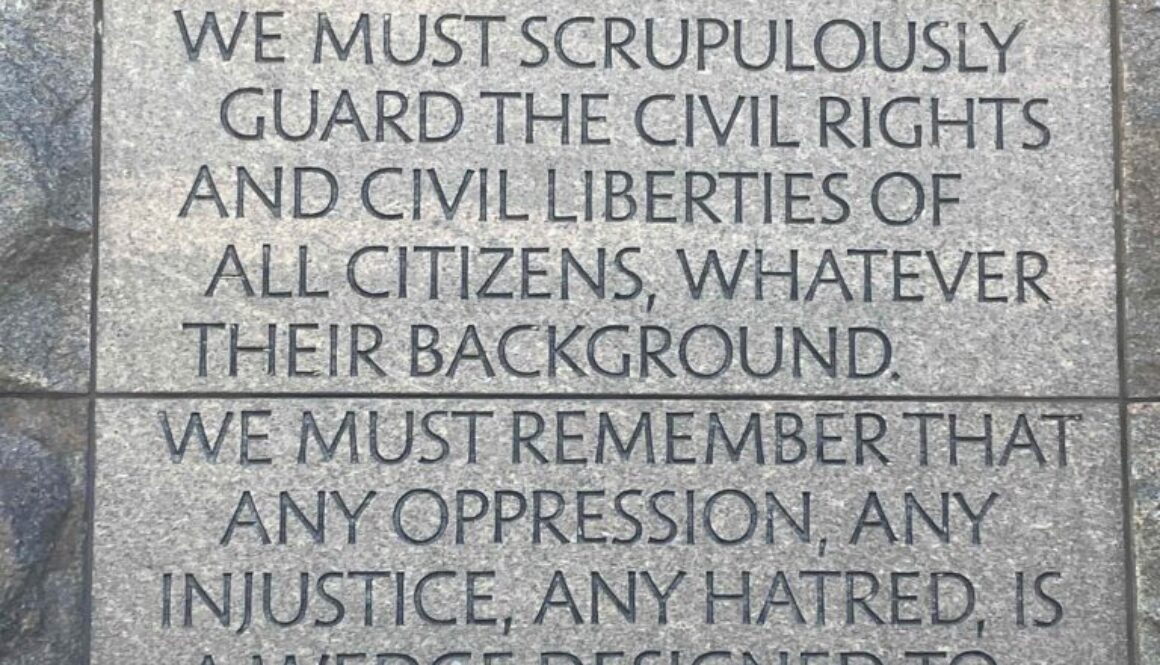
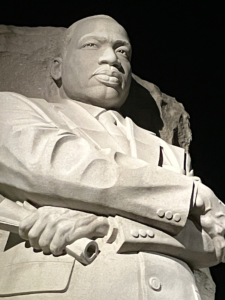 The highlight of our first day was an evening tour of the monuments. And the highlight of the highlights was the Martin Luther King memorial. Wow. So powerful, so perfectly placed, so elegantly lit with cherry blossoms surrounding it. Truly breathtaking. You should click the link and read about the memorial and how it came to be.
I was filled with gratitude for the commitment of so many that make this and other monuments possible. Under our system, while the government provides the land, all the money to build monuments must come from other sources. I am grateful that there was political will and public generosity to make this and all the other monuments and memorials. And I fear that too often we think that putting up an MLK memorial somehow erases structural racism when it is still embedded in our institutions and our culture.
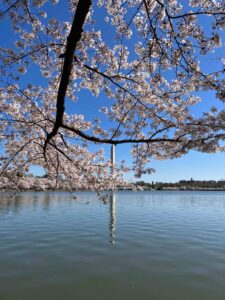
The next day we walked around the entire tidal basin admiring the cherry trees in almost full bloom. The planting of cherry trees in Washington DC originated in 1912 as a gift of friendship to the People of the United States from the People of Japan, according to the National Park Service. I’m certainly grateful that we never harmed the trees during WWII when we were doing considerable harm to Japanese-American people through our forced internment programs!
That’s enough for tonight. Monumental Thoughts, Part 2, will be posted soon, focusing on my experience in the National African American History Museum.
 I learned in school that our system of government is based on the idea that we grant power through our electoral system. Every citizen is entitled to vote for the candidates that best represent that voter’s preferences, and the candidates who earn the most votes are entrusted with certain powers according to the office to which they were elected. In the legislative bodies, whether a local city council or the US Senate, laws are enacted and policies adopted based on majority rule – the ideas that have the support of the majority of elected officials in that body become part of our societal and legal framework. When I was on the city council in my town, I could vote on budgets and zoning changes and capital investments within the limits of my city. I did not have the authority to intervene in school board, county, state, or national level issues other than expressing support or opposition. The power to act at those levels of government were reserved to the people elected to those offices.
 But here’s the thing. Those people taking those actions were elected. We, the citizens, by voting or not voting, by engaging or not engaging in the political process, we gave them the power they are now using to further their own interests and to undermine our democracy. Yes, the system is rigged. It favors those in power. It’s hard to beat an incumbent. But it can be done and it must be done.
 It is hard work. It is dangerous work. But I refuse to accept that we have to keep giving power to people who consistently block sensible gun safety measures, like a ban on assault-style weapons and large ammunition sales and universal background checks. This is not what the people want. We know that most people want better gun safety. Nobody wants to fear sending their children to school. The majority see the folly of expecting teachers to take on police responsibilities when we have seen even trained police officers failing to protect school children from armed shooters.
 It’s tax time, and I think we need to understand that our tax payments are an investment in a well-run public sector (some of which operates well today, and some of which is in need of significant reform). Without an effective government, we would not have measurement standards, for example. I could claim that my package weighs a pound whether or not it conformed to an official definition of a pound, and you, as a consumer, would have no way of knowing. You could not enforce a contract without a court system to hold signatories accountable. I could make a competing product using your corporate name and logo if there were no trademark protections. All of these things matter.
 If we only apply the laws that we like, and if we spew lies and make threats against the legal system when they hold people accountable who we want to protect, we damage our whole society. We know there are imperfections everywhere. We know that systemic bias exists. It has been well documented. We need better education and systemic reforms that are based in reality – not imaginary problems created by space lasers or dead people. Everyone’s rights deserve to be equally protected. There is much work that is needed. Violence is not the answer.