A Mormon, a Mennonite, and a Unitarian walked into …
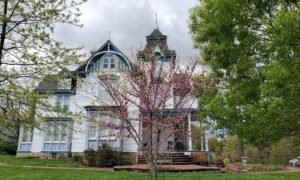 A Mormon, a Mennonite, and a Unitarian walked into a historic inn and gave me hope.
I am in Laurel, Maryland, staying at a lovely historic B&B. This morning at the breakfast table were two other couples. Holly and Dave (all the names have been changed) are members of the Church of Jesus Christ of Latter Day Saints who had traveled from Utah to tour the Mormon Temple here. (The temple has been under renovation and is open to the public until it is reconsecrated.) Andy and Jen are Mennonites from Lancaster, PA, here to visit family. I am a member of a Unitarian Universalist Fellowship in the San Diego region, visiting my daughter.
 So what did we talk about at the breakfast table? Sustainability. Climate Change. Carbon footprints. Regenerative agriculture. Open space conservation. I’m pretty sure we do not identify the same way politically (the innkeepers ask that we not talk politics at the table) but we were all on, or close to, the same sustainability page. This gives me hope. We talked about shared values and common concerns. We related as human members of our society. THIS is what we need to do more!
 Whether you believe that some higher power, possibly called God, created the world and gave “man” dominion over all the creatures, or you think we are part of an interdependent web of all existence where no specie is more important than any other, everyone at our table agreed that we have a responsibility to be good stewards of the environment. Religious differences, in other words, but core values that were the same.
Furthermore, Dave works for a very large international food company and part of his responsibilities include corporate sustainability efforts. He said that there is a substantial financial cost to meeting sustainability targets that were set by the corporate CEO. But his company has embraced the effort and incorporated these targets into management compensation calculations, creating incentives for leadership to do the right thing.
 When I said I thought the there were significant benefits offsetting the costs, Dave did acknowledge the intangible benefits (which I would argue can be made tangible) in terms of recruitment and retention of talent, as well as direct savings from reducing waste, reusing water in industrial processes, energy efficiency, and longer-term benefits from reducing future severe weather events. It’s hard to operate a factory in a tornado, wildfire, flood, or extreme heat event. And possibly more important than all this in terms of giving me hope, he was PROUD that he was working on these issues.
Andy and Jen both came from families that owned farms. Neither of them attended college. He works for a renewable energy company and one of their sons (who has a joint engineering/MBA degree from MIT – no slouch academically!) is pursuing a career in corporate sustainability. Jen told a sad story about her family’s farm that her son was trying to arrange to put into an agricultural trust in perpetuity when the family matriarch died. He wasn’t able to complete the arrangements before the property passed to Jen’s 26-year old nephew who is not interested in farming. That property’s fate is likely to be determined by financial and tax consequences, not ecological considerations. Andy’s family’s farm has already been developed into residential housing. Andy and Jen were very committed to the preservation of small-scale family farms, and to advancing sustainability efforts in their way, including participating in a local sustainability organization working at the county level to reduce their overall environmental impact.
 The innkeepers joined in the end of our breakfast discussion. They belong to a green tourism association, recently joined a CSA program, and proudly explained to me their municipal composting program, among other “green” initiatives.
This has been a very tough few weeks. Gun violence, innocent children and adults slaughtered, political campaigns centered on who will advance the gun agenda most, and the ongoing war in Ukraine, as well as continued Covid pandemic. It’s so easy to feel sad and disheartened and to lose hope.
My fellow travelers have been a delightful reminder that real people, honest, hard-working people, really do care about the same things – they want clean air and water. They want safe streets and healthy children. They want to stop contributing to climate change. We may not all have the same faith traditions or the same academic pedigrees, or use the same language, but real people are trying to find ways to get to the same outcomes. Today I am more hopeful.
 This weekend I participated in a march and rally, one of many “Bans Off Our Bodies” events to protest the anticipated Supreme Court ruling to overturn women’s right to privacy and to control of their bodies. And then I heard the news about an 18-year-old boy who was able to acquire body armor and tactical weapons and target Black shoppers in Buffalo, killing at least ten people.
 I honestly just don’t understand how anyone can see all the tragic gun deaths and injuries, and still insist that anyone, regardless of age or mental health, should be able to get any type of weapon and ammunition and tactical gear without limit. Most gun violence prevention advocates do not call for taking away legitimately obtained small-scale guns. They argue for sensible regulations – background checks, licensing, mandatory safety training, and a ban on assault weapons. I just don’t understand why that should be a problem. I don’t know how many more innocent people have to die before we can take action at the national level.
 What we need is not for more people to die – we need more living people to VOTE for candidates who WILL do the sensible thing. The Congress is dysfunctional because voters elected those people and citizens who could have voted but didn’t allowed the elections to go without their input. We DO have the power if we will just use it.